Accepting a dental treatment is rarely an automatic decision. Even when the need is real and clearly explained, hesitation is often part of the patient journey.
This hesitation is not a refusal. It is a process. Understanding this process allows clinics to better support patients, without unnecessary pressure, by focusing on communication and education.
Decisions are rarely made instantly
From a clinical perspective, a treatment plan may seem obvious. From the patient’s point of view, many factors come into play at the same time: emotions, concerns, perceptions, past experiences, and personal context.
Patients are not only processing clinical information. They are also asking themselves questions such as:
- Do I really understand what is being proposed?
- Is this urgent, or can it wait?
- What should I expect, concretely?
- Do I feel confident in this decision?
The decision rarely happens during the appointment itself. It continues afterward.
What patients actually experience during the appointment
A dental appointment is a dense moment. Patients are focused on the exam, their comfort, and sometimes pain or anxiety. Their capacity to absorb complex information is limited.
Even with clear explanations, part of the message may be lost. This is not a lack of attention, but a normal reaction to a high-stimulation environment.
That is why hesitation later does not mean the explanation was poor. It often means the information was delivered at a moment when it could not yet be fully processed.
Communication as the foundation of understanding
Good communication is not about saying more. It is about saying the right things, in the right order, with clear reference points.
Several elements consistently help patients make sense of what is being proposed:
- explaining the why before the how
- breaking information into simple ideas
- using accessible language
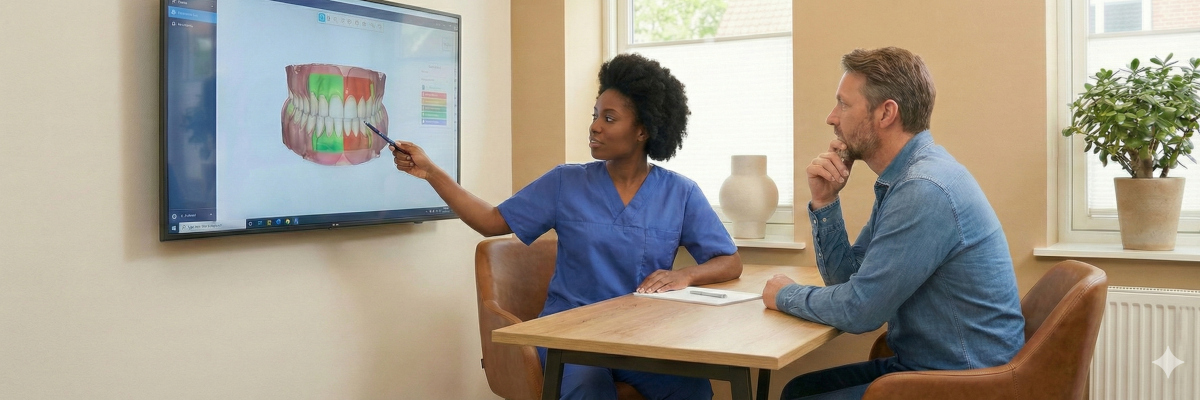
- supporting explanations with visuals when possible
When information is structured and clear, patients feel less overwhelmed and more capable of engaging in the decision.
Education as a lever for confidence
Understanding a treatment helps patients regain a sense of control. Education transforms a passive moment into an active reflection.
Well-informed patients tend to feel less anxious, ask better questions, and approach decisions with greater confidence.
The goal is not to convince. It is to support understanding.
The decision often happens after the appointment
For many patients, real reflection begins once they are back home. In a calmer environment, they revisit what was discussed and reassess the information.
This is often when doubts surface and when the decision either becomes clearer or gets postponed.
Without access to information after the visit, the decision process can easily stall.
Mordicus as a reflection of the patient decision journey
Through our work with dental clinics, we observe that hesitation is not a failure point, but a normal stage in the patient decision-making process.
Mordicus was built around this reality. The tools are not designed to rush decisions, but to support patient reflection by making relevant information available when patients are ready to engage with it.
When patients can revisit treatment plans, review visual explanations, or take the time to process information at home, decisions tend to become less emotional and more informed.
The goal is not to push acceptance, but to respect the natural rhythm of decision-making.
Conclusion
The patient decision-making process is nuanced and rarely instantaneous. By focusing on clear communication and meaningful education, clinics can transform hesitation into understanding.
Supporting decisions, rather than forcing them, helps build long-term trust between clinics and their patients.
See you soon!